
When a boiler fails, the household loses central heating and hot water, and the repair bill is rarely something you’ve planned for. What you pay depends on the fault, the type of boiler you have (combi, system or regular), its age, etc.
In the UK, a standard boiler repair typically costs around £120-£750, including parts and labour. More involved faults, such as a failed heat exchanger or PCB (printed circuit board), can reach £300 or more. Emergency call-outs, out-of-hours rates, parts and labour can all raise the final bill.
Below, we set out how much does a boiler repair cost, and the factors that influence pricing. We’ll also discuss the signs that indicate a boiler needs repair and how to keep repair costs down. Let’s start.
How Much Does A Boiler Repair Cost in the UK? Pricing 2026
A boiler repair usually costs between £120 and £750. However, the final bill depends on many factors. It can be a minor or a major repair. Let’s have a look at the typical pricing:
Typical Boiler Repair Costs:
| Service Type | Typical Range |
| Standard Repair(parts and labour) | £120-£750 |
| Standard Call-Out Fee | £75-£120 |
| Emergency Call-Out Fee | £150-£250 |
| Annual Boiler Service | £80-£120 |
| Gas Engineer Hourly Rate | £50-£80 |
Boiler Repair Cost By Fault Type:
| Fault Type | Estimated Cost (Parts+ Labour) |
| Boiler Reset or Minor Leaks | £80-£130 |
| Central Heating Filter Clean | £80-£120 |
| Thermostat/Programmer | £120-£220 |
| Automatic Air Vent | £100-£150 |
| Gas Valve | £180-£320 |
| Boiler Fan | £180-£350 |
| Diverter Valve | £200-£380 |
| Water Pump | £220-£400 |
| Printed Circuit Board(PCB) | £230-£450 |
| Kettling Repair/System Flush | ~£300 |
| Main Heat Exchanger | £450-£750+ |
Boiler Repair Labour Costs:
| Labour Type | Approximate Cost |
| Hourly Rate | £50-£80 |
| Day Rate | £300-£450 |
Boiler Repair by Regions:
| UK Region | Call-Out Fee | Minor Repair Total | Major Repair Total |
| London and Inner Suburbs | £90-£150 | £150-£300 | £300-£600+ |
| South East | £80-£110 | £140-£260 | £280-£520 |
| South West | £75-£95 | £125-£240 | £265-£470 |
| Midlands | £70-£90 | £120-£230 | £250-£450 |
| North West | £65-£85 | £110-£215 | £240-£430 |
| Yorkshire and Humber | £65-£80 | £110-£210 | £235-£420 |
| North East | £60-£80 | £100-£195 | £220-£400 |
| Scotland | £70-£90 | £120-£235 | £250-£450 |
| Wales | £70-£85 | £115-£220 | £240-£435 |
| Northern Ireland | £60-£75 | £100-£190 | £210-£380 |
Why Do Boiler Repair Costs Often Vary?
Boiler repair costs vary because the final bill is built from several separate variables. Any one of them can move the price significantly. Common culprits are:
The Severity of the Fault
Simple fixes, such as resetting boiler pressure or bleeding a radiator, take little time and need few or no parts. Faults involving major components, such as a heat exchanger, PCB (printed circuit board), or pump, require more diagnosis and more labour hours.
Boiler Type and Model
Combi, system, and regular boilers have different internal layouts. For instance, combi boilers often have more compact, complex assemblies (such as the diverter valve and plate heat exchanger). Parts for premium or less common models usually cost more than parts for widely used ones.
Boiler Age and Part Availability
Older boilers may need parts that are discontinued or hard to source, which raises both the part price and the time spent finding it. Once a manufacturer stops supporting a model, repair may not be possible at all.
Labour Rates and Location
Engineer hourly rates and call-out fees differ between regions, with London and the South East typically higher than other parts of the UK. Some engineers charge a flat call-out fee plus parts, while others bill by the hour.
Urgency and Timing
Emergency, evening, weekend, and bank holiday call-outs usually carry a premium. Booking a standard appointment is generally cheaper than requesting same-day or out-of-hours attendance.
Diagnostic Time and Accessibility
A fault that is easy to trace takes less time and costs less than an intermittent or hidden one. Boilers installed in lofts, tight cupboards, or hard-to-reach spots can also take longer to work on, which adds labour cost.
Servicing History and Cover
A boiler that has been serviced regularly is more likely to have a quicker, cheaper fix. A manufacturer warranty or a boiler cover plan can reduce or remove the repair cost altogether.
Gas Safe Registration and Quality of Work
Legitimate boiler repairs must be carried out by a Gas Safe registered engineer. The cost may seem high, but quotes from unregistered or very cheap providers may lead to repeat faults or invalid warranties.
When Do You Need a Boiler Repair? Key Signs
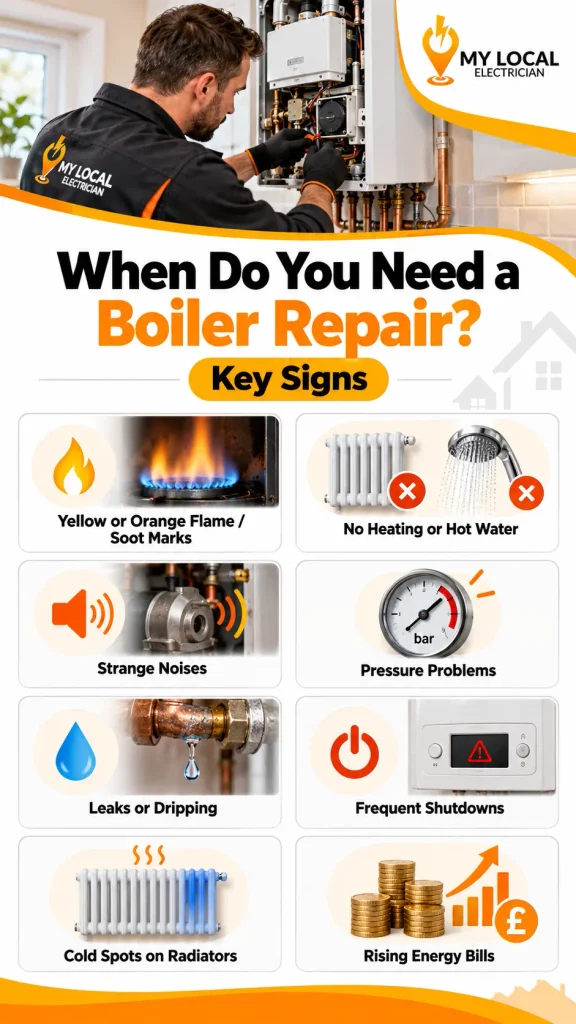
Boilers rarely fail without warning. Spotting early fault signs can save both time and money. Common signs include:
Yellow or orange flame, or soot marks:
A healthy flame burns blue. A yellow or orange flame or black staining can indicate incomplete combustion, which produces carbon monoxide. Switch the boiler off and call a Gas Safe registered engineer right away.
No heating or hot water:
A complete loss of either is the clearest sign of a fault. Common causes include a failed diverter valve, faulty pump, frozen condensate pipe, or PCB fault.
Strange Noises:
Banging, whistling, or gurgling sounds usually point to limescale build-up on the heat exchanger, trapped air, low pressure, or a failing pump.
Pressure problems:
Sealed systems should sit at roughly 1-1.5 bar when cold. Regular drops below 1 bar may mean a leak. Readings above 2-3 bar can indicate a faulty expansion vessel or pressure relief valve.
Leaks or Dripping:
Water around the boiler or pipework suggests a failed seal, pump, or joint. Leaks can also damage electrical parts.
Frequent shutdowns:
Repeated lockouts can stem from a faulty thermocouple, low pressure, a blocked condensate pipe, or ignition failure.
Cold Spots on Radiators:
Cold at the top usually means trapped air; cold at the bottom suggests sludge or magnetite build-up in the system.
Rising Energy Bills:
If your gas use climbs without a change in habits, the boiler may be running inefficiently because of scale, a failing component, or lack of servicing.
Age or Overdue Service:
Boilers generally last around 10 to 15 years. Older units or those unserviced for over 12 months are more prone to faults, and parts may be harder to find.
Should You Repair or Replace Your Boiler?
When a boiler breaks down, the choice comes down to cost, age and reliability. A one-off repair on a newer boiler is usually good value. But repeated faults on an ageing unit can cost more over time than a new installation.
When Do You Need Boiler Repair?
Repair is usually the better option if:
- The boiler is under about 10 years old: Most boilers last 10-15 years, so a newer unit has plenty of working life left.
- The fault is minor: Replacing a thermostat, pump, diverter valve, or similar part is typically far cheaper than a new boiler.
- Parts are readily available: Popular models from major manufacturers are generally easy to repair.
- It is still under warranty: Many manufacturers cover parts and labour for several years, provided the boiler has been installed and serviced correctly.
When Should You Replace Your Boiler?
Replacement is usually the better option if:
- The boiler is over 10-15 years old: Efficiency declines with age, and breakdowns become more frequent.
- Repairs are becoming regular: Repeated call-outs add up quickly and signal wider wear.
- The repair is costly: A major fault, such as a failed heat exchanger, can approach the price of a new boiler.
- Parts are discontinued: If a manufacturer no longer supplies parts, repair may not be possible.
- Efficiency is poor: Older non-condensing boilers can be around 70-80% efficient. But modern condensing boilers reach about 90% or more, which can lower gas bills.
How to Keep Boiler Repair Costs Down
You can’t prevent every fault that is going to happen in your boiler. But a few habits reduce both how often the boiler breaks down and how much each repair costs.
Service the boiler every year:
An annual service by a Gas Safe registered engineer catches worn parts, scale build-up and pressure problems before they become breakdowns. Many manufacturer warranties also require proof of annual servicing.
Act on early warning signs:
Unusual noises, falling pressure, or a boiler that keeps shutting down are cheaper to fix when addressed early. Ignoring them can damage other components. Call certified professionals as early as possible.
Bleed radiators and check pressure:
Trapped air makes the system work harder, and low pressure can cause lockouts. Bleeding radiators and topping up pressure to around 1-1.5 bar (as your manufacturer specifies) are simple tasks you can do yourself, following the boiler manual.
Fit a magnetic system filter:
A filter captures magnetite sludge circulating in the heating system, which otherwise wears the pump and heat exchanger. It is a relatively low-cost addition that can extend the boiler’s life.
Protect against frozen condensate pipes:
In winter, the condensate pipe on a condensing boiler can freeze and shut the boiler down. Insulating the external section, or having it re-routed or enlarged, can prevent this common and avoidable call-out.
Consider a boiler cover plan:
A service or repair plan can spread the cost across monthly payments and cover call-outs and parts. Compare the terms carefully, including excluded faults, age limits and annual caps, to check it offers real value for your boiler’s age.
Get Multiple Quotes:
For anything beyond a minor repair, compare written quotes from Gas Safe registered engineers. Check that each states the parts, labour and call-out charges separately.
In Conclusion
You can’t say an exact number for how much does a boiler repair cost in the UK. A standard rate for boiler repair typically falls between £120 and £750 for many common faults. Complex repairs can cost considerably more. The final price depends on the faulty component, labour, replacement parts, location, etc.
Before deciding what to do, get a clear quote, check your warranty, and consider your boiler’s age and repair history. A straightforward repair may be the best option for a reliable boiler. In contrast, repeated breakdowns or a major component failure may make replacement worth considering.
Do not ignore persistent faults or attempt unsafe DIY repairs. A qualified Gas Safe registered engineer can diagnose the issue. You can also consult professional experts like My Local Electrician to explain your options.
Your Most Asked Questions About Boiler Repair Costs
What is the average cost of repairing a boiler in the UK?
The average cost of repairing a boiler typically ranges from £120 to £750. The pricing can vary depending on several factors.
What is the average lifespan of a boiler?
The average lifespan of a boiler is usually 10 to 15 years. With proper maintenance, a boiler can last up to 20 years or more.
How much does a boiler engineer charge per hour?
A boiler engineer typically charges £50 to £80 per hour. The hourly rate can vary from engineer to engineer.
How much does it cost to repair a leaking boiler?
The cost to repair a leaking boiler can range from £150 to £500. The average rate for a leaky boiler is usually around £300.
Does boiler repair cost more in an emergency?
Yes, emergency boiler repairs often cost more than standard appointments. Engineers may charge additional fees for evenings, weekends, bank holidays or urgent call-outs.
Does home insurance cover boiler repair costs?
Standard home insurance does not usually cover boiler breakdowns caused by wear and tear or mechanical failure. Some policies may cover damage caused by an insured event. A separate boiler cover or home emergency cover may pay for eligible breakdown repairs.
How much does an emergency boiler repair cost?
An emergency boiler repair may cost around £225–£675 or more, depending on the fault, time of the call-out and parts required.